
Creative Profile: Peter Griffen
Peter Griffen is a visual artist who lives and works in the Inner West of Sydney. He has spent over five decades painting and drawing. Peter exhibits in galleries around Australia and also conducts studio workshops, teaching his broad range of skills. His manifesto: ”I believe to make discoveries, risks must be taken, the traveller must get lost. A well planned journey can only lead to an already known destination. From chaos the universe was formed”.
Peter is a member of the Australian Watercolour Institute, and is President of the Glebe Art Society. The Glebe Art Society is responsible for the Inner Sydney Art Centre Initiative (ISAC) which is advocating for the setting up of a Public Regional gallery to fill the gap in Inner Sydney.
You have been an artist for a long time. How have conditions for you as a professional Australian artist changed over that time?
My theory has always been that I should strive to make good art. If it is good I hope that it would be recognised as such and I would benefit financially.
I was teaching high school maths and geography as well as painting in the seventies. Perhaps it was that my painting style was so obscure that sales were difficult. I opened my own gallery in Adelaide which helped.
I met my wife Denise Lithgow in Adelaide, then she moved to Sydney and so did I. She supported me to start with and since then we have worked together as a team. She was a theatre sister in a local hospital and is now a much respected fibre artist.
In Sydney I went to art school for four years and since I have been successfully full time painting. In 2000 I started teaching workshops in Australia and overseas and this was beneficial.
I have also had many solo and group exhibitions throughout Australia and overseas.
For twenty seven years Denise and I have lived in a warehouse in the inner west of Sydney. This helps by us living and working in the same place; I teach workshops in my studio and am convenient to the art market.
In some of your work you have created low relief by cutting into or attaching objects to the surface. Is this because you can’t decide whether you are a painter or a sculptor?
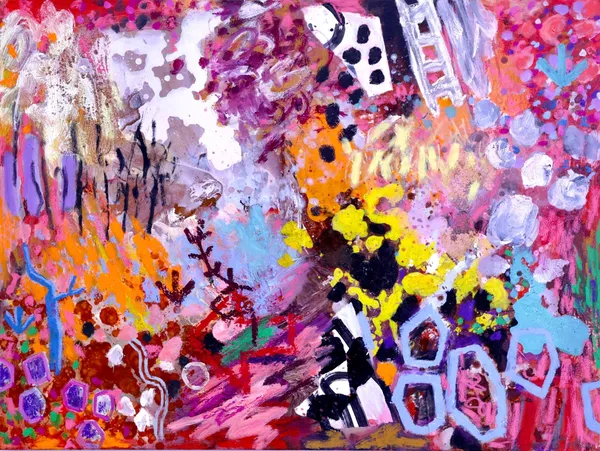
I am a maker of things. Some of my paintings could be described as low relief works. I like to feel that I can do what I want with whatever I want; usually it is painting, making marks, dripping, drawing into the painting, using a wide range of media.
Some of your works take inspiration from nature eg your boab tree paintings. What is it about the natural world that you want to express?
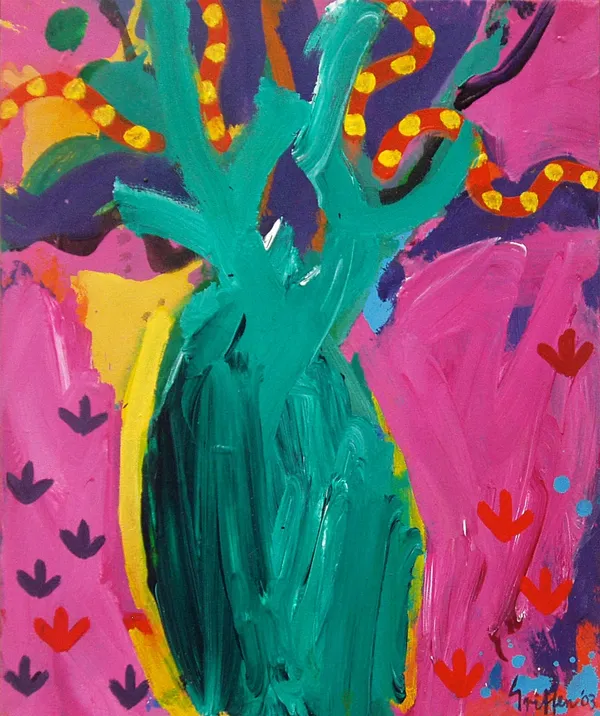
Many things. With the particular boab known as ‘the prison tree’, there is a dark history which I am aware of apart from enjoying its comic theatricality. Most of all I want to express my appreciation of and fascination with the natural world. I am a natural being in a natural world. I want to harmonise with it.
There often seems to be an element of humour underlying your work. Is this because you are naturally playful or do you think the world is a bit ridiculous?
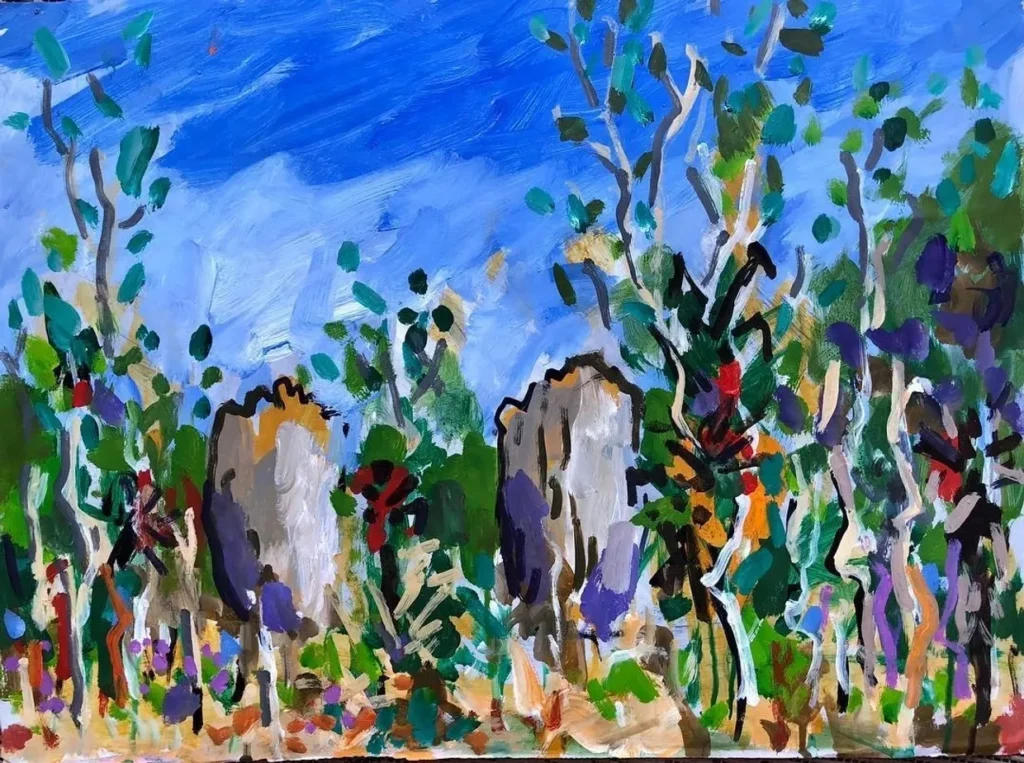
Many people appear ridiculous, it is true. Nature seems very sensible. I guess I like to refer to both extremes at times. In 1980 when I came to Sydney from Adelaide, I was excited by the spectacle of the harbour and so responded to it with my paintings. Then around 1985 I went with a friend to Lightning Ridge opal mining sites where I was smitten by both the colourful drama of man-land activities and the humorous character of the people. I suddenly began to paint distant abstract landscapes with a quirky character in mind. Farmyards and opal mining sites, are characterised by various odd objects, neglected machinery and buildings, aging and certainly colourful. My depiction of these elements can be playful and somewhat exaggerated.
Can you tell us what is the purpose of groups like the Glebe Art Society of which you are President?
The benefits are many. The GAS gives local artists a chance to show and sell their work. All are accepted to hang. There is a feeling of comradery, of connection to the community. Viewers who may not be familiar with the commercial gallery scene have a chance to see what is going on and are given a chance to purchase art, usually at affordable prices.
The Glebe Art Show was set up by Robin Lawrence to help raise funds for the establishment of a library in Glebe. This was a success. Now, during the Glebe Art Show, twilight concerts are staged. The GAS also hosts an event, ‘Art in the Park’, where all artists are invited to join in a day of plein air painting beside the Glebe foreshore.
The ambition of the Society’s Inner Sydney Art Centre Initiative is for a Public Regional gallery to be set up somewhere in Inner Sydney. Can you tell us what is the concept for this and how is this campaign going?
We believe that this part of Sydney needs a focal point for its many and varied artistic activities. An inner Sydney arts centre (ISAC), could benefit the local visual arts by having galleries to show local and visiting artists. There could be meeting rooms, studios for artists including for painting and drawing, printing, photography and for teaching. Perhaps a library could be established and a collection of acquired art. The list goes on. ISAC could be part of the regional gallery network.
We’ve had two well attended meetings where ISAC was discussed. Everybody agrees that ISAC is a good idea and much needed and that Callan Park is the perfect place for it. So submissions have been made to the Callan Park Plan of Management. Kobi Shetty, Member for Balmain, is supporting our quest and has asked the Department of Health for permission for us to visit the now abandoned Ambulance Centre in Callan Park where we are thinking about starting the centre based on volunteers.
IWC Mayor Darcy Byrne also supports ISAC. However, we’ve had no success in pitching to be located within the White Bay Power Station. And there’s been no response to our letter to the Prime Minister’s Office.
Tamara Winikoff is an independent consultant with extensive experience in arts advocacy, policy, and cultural leadership. She was a a founding member of the Inner West Creative Network and served as Executive Director of the National Association for the Visual Arts (NAVA) for 22 years, championing artists’ rights and sector development. As Co-convenor of ArtsPeak, she coordinated national arts policy initiatives. Previously, she managed the Community, Environment, Art and Design (CEAD) program at the Australia Council for the Arts and lectured in Cultural Environment and Heritage at Macquarie University. Based in Sydney, she continues to influence the cultural landscape through strategic consultancy.