
Creative Profile: Justine Wahlin
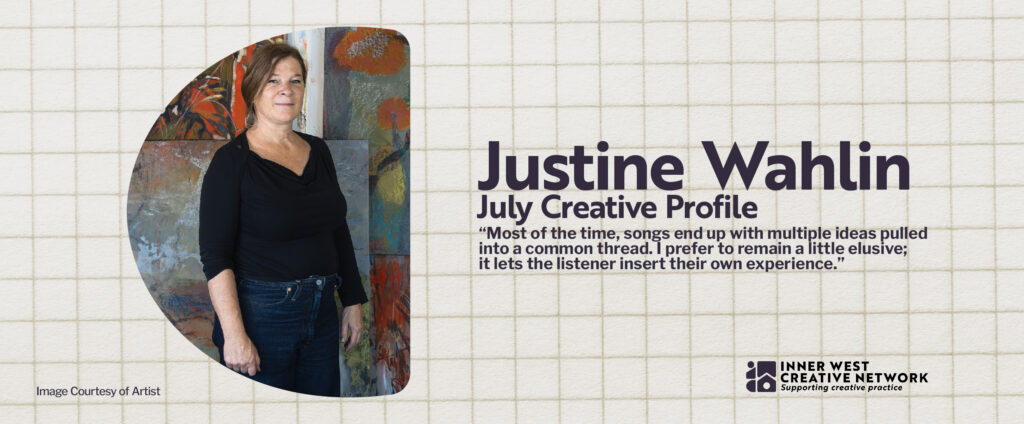
Justine Wahlin is a multidisciplinary musician and visual artist. She comes from a long line of artists and has grown up amid the smell of oil paint and role models who have instilled in her a deep reverence for art and music. In her own visual artwork she uses sculpture, watercolour, acrylic paint, ink and collage to examine the intersection of nature and human experience. Also exploring film and animation, she has a small swag of short films and music videos under her belt, some accompanying her own songs as well as films she has made for other artists. Born in Sweden to a Swedish father and an Australian mother, Justine arrived in Australia as a very young child. Across two worlds with wildly different landscapes, she draws on a sense of both displacement and belonging. During her formative years in the 90s and early 2000s, she played bass in bands, in the last 10 years emerging as a songwriter and performer in her own right. Her most recent album released in 2019 is ‘A Pair of Dreamers’. She is aiming to release a self-produced album in the near future.
You describe your childhood as “free range, hopping between mining towns and living in caravans until the age of 12”. What were the pros and cons of this sort of childhood?
Always being the new kid at school and leaving friends behind was tough at times. At one point we changed schools so frequently, mum made us school clothes we dubbed the Wahlin school uniform; both embarrassing and awesome in hindsight. The upshot is that I’m close to my siblings, and I think all three of us are resilient and adventurous. Home could still be around the corner and this keeps me inspired.
Your work encompasses so many mediums that it’s hard to know where to start. What training have you had in each of your chosen forms of expression?
I’m the sort of person who leads with an idea and I try not to let things like training slow me down, but we now have unlimited resources to explore creative ideation so I’m always learning. Sticking to one thing has never been me. I have about 5 projects going at a time, resting some until that breakthrough idea comes through. I was delighted to hear an interview with Joni Mitchell where she outlined the same sort of process!
In your visual arts practice, you have said you want your work to be “not only aesthetically pleasing but also thought provoking and emotionally resonant”. How do you try to achieve this?
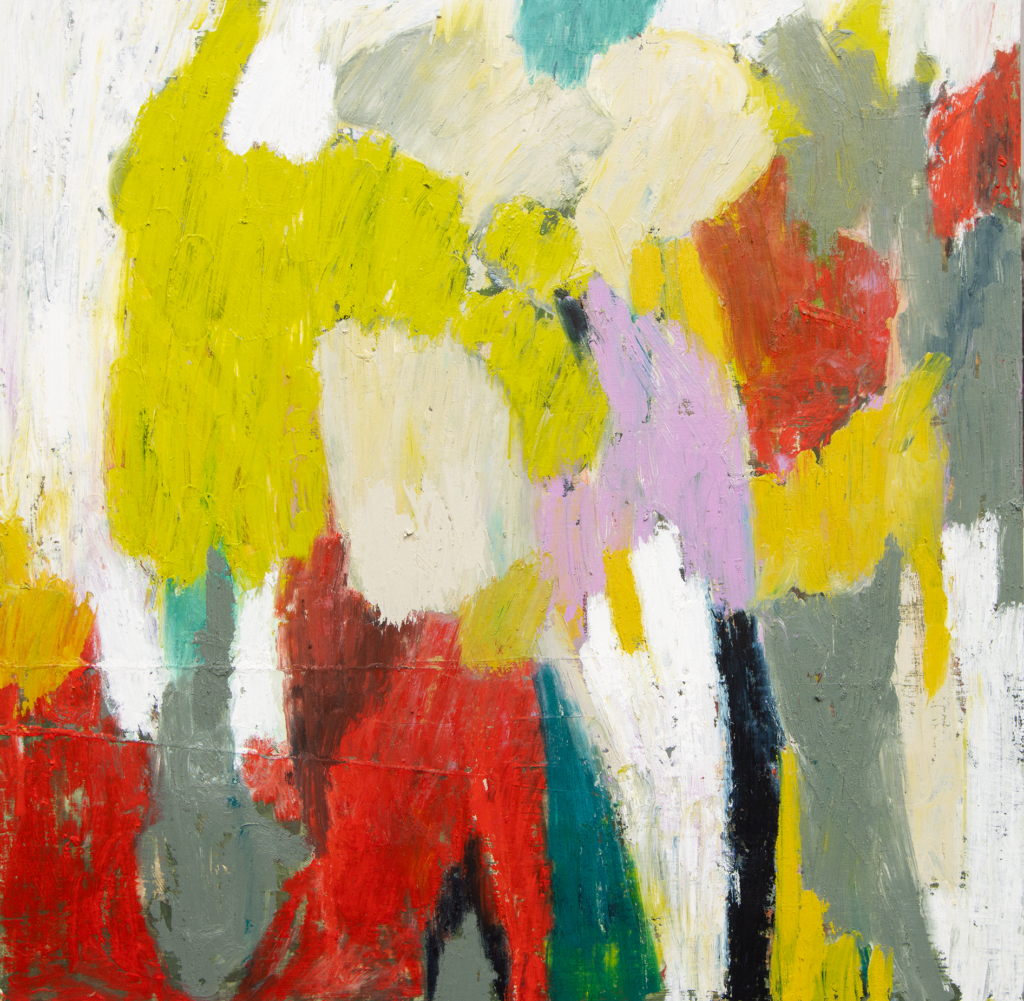
For me a painting is finished when I feel life come into it. That could be three brush marks or 15 underpaintings but it’s like coaxing something to life and then suddenly there is a breath. I usually stop there. When a painting has breath, it usually has resonance for me and I’ve found this is a good indication that others will feel something too.
What is the relationship between the abstract and figurative in your work?
I work both abstractly and figuratively. Sometimes there is a mid-point where the two exist to form whimsical notions of realism. In all honesty this is where the magic happens and some otherworldly visions come through.
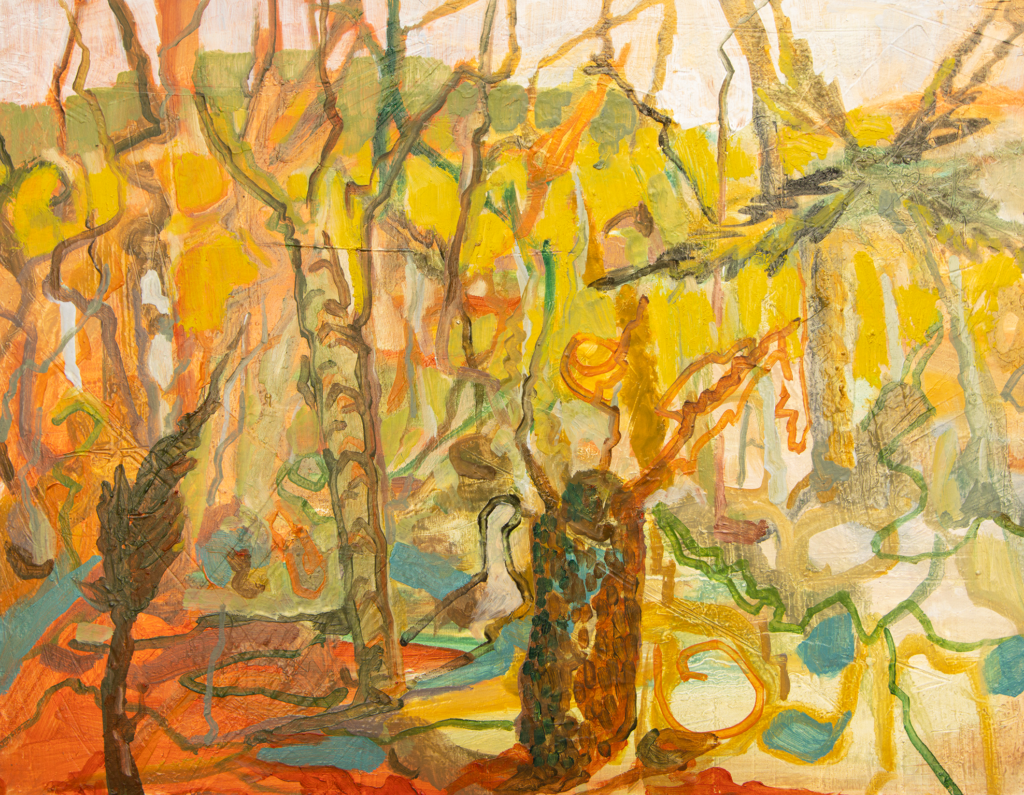
Your ‘Wild Calm’ exhibition catalogue describes your work as “emerging from line drawings made directly in response to moving through the landscape”. Can you elaborate?
For Wild Calm I filled numerous sketchbooks, scribbling shapes and lines from nature walks before stopping to think. It was a wonderful process to focus on shapes as they were, and not try and interpret them in any way. Back in the studio I replicated the marks, layering them up until they rebuilt the scenes in different ways. I feel they represent place with the true emotion of being in these spaces.
You had exposure to a lot of music in your growing up. What has most shaped your musical expression?
Music was a big part of my childhood but I’m self-taught. I’m a lyrical songwriter, so words have shaped my musical expression the most. I have a long history of performing with my sister Willhamina, so she is a massive influence. My partner of 10 years Peter Fenwick, also a musician, has really challenged me to leave my comfort zone and experiment more.
How would you describe your own creative musical process?
For a time, songs just poured out of me. My head was full of ideas and lyrics, but as with all things, at some point you have to ‘do the work’. In recent times l’m inspired by playing instruments I can’t really play. Being free to make different sounds opens possibilities in different ways.
What informs the subject matter in your songs and video clips?
Things that happen, things that might happen. An idea often starts with some small epiphany or connection, or some observation that stays with me. Most of the time, songs end up with multiple ideas pulled into a common thread. I prefer to remain a little elusive; it lets the listener insert their own experience.
With video, I like to layer ideas with possibilities. I guess I’m a bit inspired by surrealist story telling.
In relation to your films, what can you do better in animation than in live action?
With animation, there is no limit to the worlds you can create! Animation lets the imagination run freer and allows you to blend reality with the fantastical.
You say you believe in doing things that scare you. What fruitfully scares you as a creative person?
As a creative person, the thing that scares me most is not creating! Aside from that, taking each leap of complexity, scale and commitment is scary. At each stage you face areas of your practice that are not fully developed. Sometimes you can’t visualise the finished work, but with each push you stretch the bounds of your enquiry and get closer to saying something potentially important.
Tamara Winikoff is an independent consultant with extensive experience in arts advocacy, policy, and cultural leadership. She was a a founding member of the Inner West Creative Network and served as Executive Director of the National Association for the Visual Arts (NAVA) for 22 years, championing artists’ rights and sector development. As Co-convenor of ArtsPeak, she coordinated national arts policy initiatives. Previously, she managed the Community, Environment, Art and Design (CEAD) program at the Australia Council for the Arts and lectured in Cultural Environment and Heritage at Macquarie University. Based in Sydney, she continues to influence the cultural landscape through strategic consultancy..