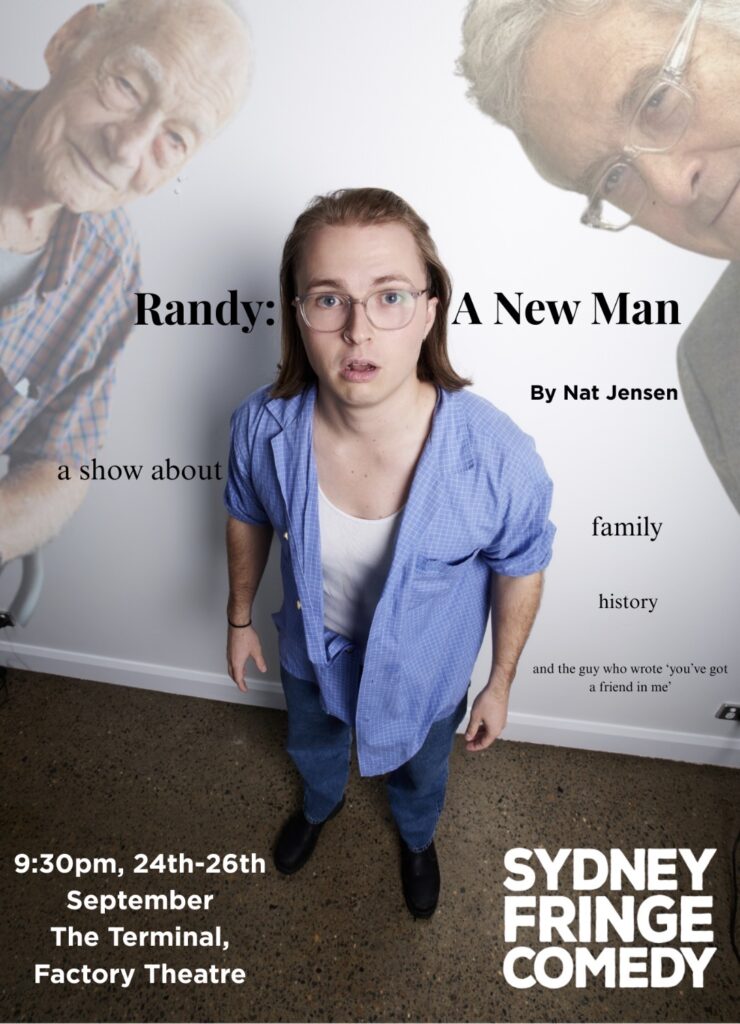
Creative Profile: Nathaniel Jensen
Nathaniel Jensen is a comedian who has been acting, writing, and performing for the past 6 years at various theatres and festivals across Gadigal land, Sydney, and teaching Drama and improv in high schools and adult classes. His work has been shortlisted for Sydney Fringe and he has also won several improv competitions, including Improv Theatre Sydney's Smackdown (2023), Improv Comedy Cagefight (2023) and Scared Scriptless (2025). He has a plethora of performance experience on screen and off, including hosting and producing his musical improv comedy podcast ‘We’ve Got Earworms’. Nat is always expanding his comedic and performance abilities by creating live sketch shows, doing improv comedy, performing stand-up comedy and acting in plays, and doing as much fun stuff as he can, all while finishing his degree in Journalism at UTS.
- When did you start doing improv theatre?
I’ve been doing improv for just about 5 years now. I moved to Sydney in April 2021 and started improv classes at Improv Theatre Sydney (ITS) in September. I very randomly started teaching improv for a different improv school (Improv Comedy Cagefight but we don’t talk about that) and then started teaching Improv, TheatreSports and Drama in high schools as an extra curricular. I love doing it and teaching it. It works for my brain.
I originally wanted to pursue a career as an actor. During my year 12 studies, I went to acting school in Canberra, in the gorgeous, stunning and electric suburb of Fyshwick (famous for its DFO and brothels!). One of my acting teachers said that I was a good enough actor but I should really just do improv. I still love acting, but improv is sort of the way I keep performance ready for plays and stuff.
Improv teaches you the brushstrokes of performance: a sort of creative literacy. A few key rules of it: Yes And, Yield, Don’t Block and Do The Thing. In my own words: accept all ideas and build on them with whatever comes to YOUR mind (you must bring yourself - your voice, style of humour, opinions, to all shows), make space for all performers and their ideas (allow others to bring themselves), don’t block another’s idea (if the idea is harmful/uncomfortable, then pivot, negotiate, or call it out), and commit as much as humanly possible (bring energy always and honour what is said). If all these things are done right, then improvised theatre can have the potential to be the best piece of art you will ever see. Truly.
Practicing, performing and honing these simple things are excellent ways to expand on all facets of creative outputs, facets of life generally. I am a hands-on learner and the freedom of improv allows you to play with every sort of performance. I get to learn how to do a variety of styles of performance. I’ve done shows with short witty scenes, long-form narrative improv, soap operas, dramatic improv, musical improv, recorded musical improv podcasts, improv cine-theatre, improvised stand-up comedy, even improv that was used to create actual film scripts. Improv is an art form, a medium and a practice that makes you little to no money but I do it because I love it.
On my 20th birthday, I remember saying to my family that this time next year I want to be performing once a week. By 21 I was doing just that. It’s one of those things, like a lot of creative things, that you just do all the time. I feel like I’ve been performing most of my life, not in a masking sense necessarily, but I just like to entertain people.
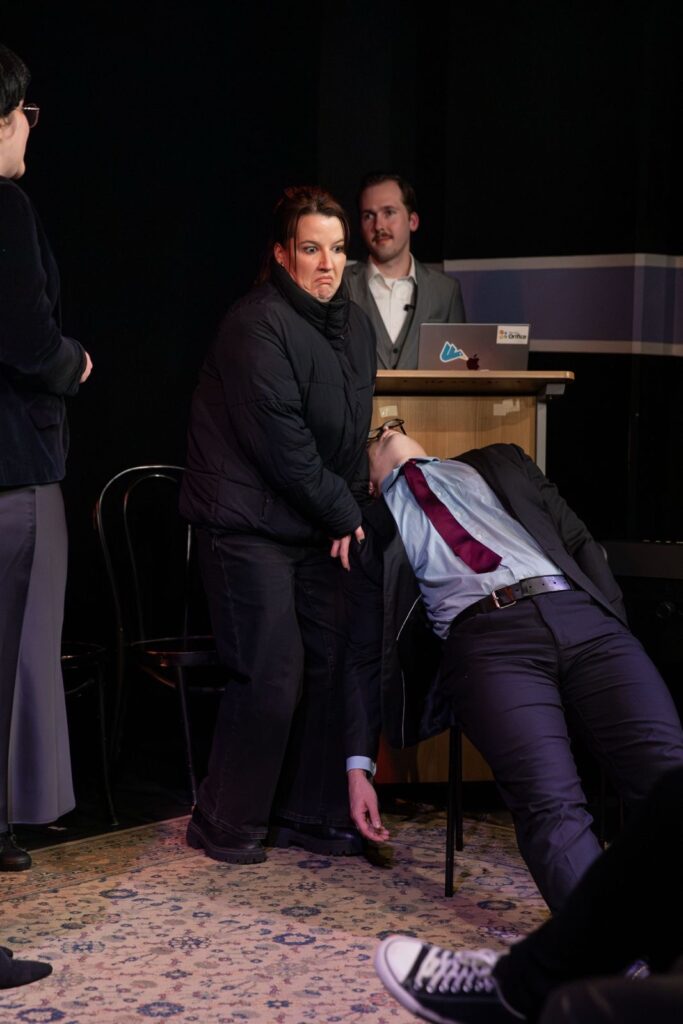
- How has sketch helped you platform through virtuality? How much scripting is involved in this process?
Being any sort of artist in this day and age requires having an online presence. And I fucking hate that. I am 30 times better live than on camera. Because I love seeing a room full of people laugh rather than getting a hundred likes on a video. The metric of likes, views and shares, the algorithm, sort of gamify expression which is frustrating but a necessary evil that my sketch partner, Nathan Roach, and I had to account for.
We’ve tried to hone a style that goes against the norm of what you see when you scroll the homogenous algorithm. Our videos are weird, hastily put together, and very much us and our voice. We want to portray ourselves as heightened characters. I find that it brings a more personal touch for a potential audience. Letting them in on who we think we are as these heightened characters leaves little to the imagination with how we came up with the video.
Sketching writing is usually a marriage of improvising and writing. Nathan and I improvise a lot, find an idea we like - usually a niche funny thought that has some novelty if you post it on the internet - then write on that idea for a bit and then shoot a video. We usually end up improvising the majority of the video, which makes the editing a challenge but makes for a quick, sharp and weird sketch. You can follow me on instagram with @natojenso or my sketch page with Nathan Roach, @gorseisgood.
When I write a sketch on my own for a show, I normally wait for an idea to hit me in the face and find out why that idea is fun for me to do. Why did it insist on hitting me in the face? Why did this idea wake me up at night? I write until it makes me laugh, and keeps making me laugh. If it doesn’t make me laugh, I usually stop writing it until I think of a way to find its ticklishness.
- What is required to craft a piece using the domestic environment as the stage?
I can chop it down to a word. Necessity. Or actually convenience. Or actually limitations. When I started filming sketches with Nathan, a fair portion of our ideas really do come from our surroundings and our interactions, the rest comes from jokes we’ve thought of when we’re in the sweet spot between consciousness and presentness. It just so happens that we’re usually in my or his home.
Limitations, and rules, are brilliant tools for comedy. It breeds creativity and simplicity. You must use what you have, your location, objects, your own damn brain etc, to make something engaging, funny, and novel. It’s one of my favourite things about creating comedy and art. It's hard but it's so worth it.
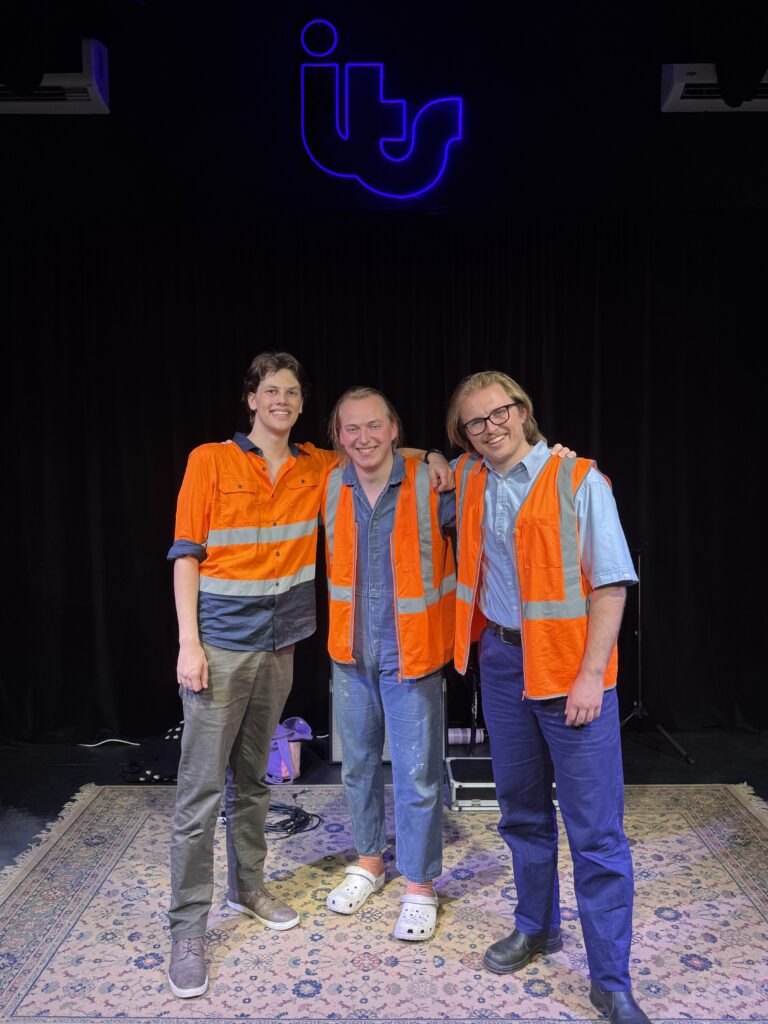
- What is the biggest challenge for a stand up comedian nowadays?
At its worst Open-mics are like comment sections on facebook. Sometimes you go and you get surprised by a nuanced take but usually you go and feel angry thinking ‘why did I come here?’. Though at its best, open mics are incredible displays of the diverse human brain and its thought patterns. I’ve been to open mics and left disgusted and inspired some at the same time like taking a shit in front of an infinite mirror. They are a fascinating place. An ecosystem of human ego and expression. I find it a challenging space, one that is draining but incredibly rewarding. Typically at open mics, folks often sign up for a night of 30 people, you can sit for hours waiting for your name, then you go up, do a 3-5 minute set, then you’re done. You have such a short amount of time to be funny that it develops a sense of comradery with other comics. Also, it's really worth positioning myself here: I am a white man who presents hetero. My challenges with standup are nowhere near the challenges of a woman, a gender diverse person, a person of colour, or any minority. It is definitely a privilege that I am able to observe and experience it in this way.
For me, there are two main challenges for standups nowadays. The first is having an online presence and the discipline of consistency. It’s pretty much impossible to find success, acclaim, and opportunities as a comedian without posting clips online, especially in this country, where the arts are vastly underappreciated. A lot of the time comics, like most middle-class creatives, have full time work. Maintaining a career in the arts whilst having a normal career is incredibly taxing. It's incredibly taxing to one’s mental health but you just do it. I’ve been working, studying at uni and doing comedy for the past 5 years. At times, I couldn’t fathom how I would get through a busy period with the work load I gave myself but you just do.
The second issue is the prevalence of, mostly men, who ask “are you allowed to say whatever you like?” It’s a question I fucking loathe because fucking yeah, of course you can. The ‘issue’ of freedom of speech is so overblown because I have seen some heinous words be spoken at open mics, sometimes funny, sometimes awful. But the “woke mafia" aren't at the door of every open mic waiting to cancel some fresh-faced 45 year old sad sack man. A lot of open mic men are pretty fucked up. But stand ups are fucked up. Some are genuinely traumatised, on their last social capital, trying to make something out of something transphobic or racist or sexist or homophobic or…. It just doesn’t work (usually) because people, and this is controversial, don’t like hate as it is, famously, uncomfortable.
As a standup, it's your goal to be funny and craft an act. That's very different for everyone. I love to workout material on stage meaning I’ll have something in my brain that I think could work and go up and find the words in front of the crowd, others write before going up and hone in on the writing of the joke, some go up with nothing at all and figure it out. The best open mics are the ones that are a ‘no arseholes’ room. Meaning standups can work on material that is taboo, or offensive, or gauche, or niche, but if the performer isn’t a dickhead, and depending on the content of the joke, it can be a very wholesome and intriguing experience.
One of my favourite experiences doing standup was watching somebody else at the Newtown Laugh Inn. A guy just bombed, he storms off annoyed at the audience - I find it fucking hilarious when a standup storms off. That's like a pilot flying a plane, crashing the plane, and blaming the passengers. The next act was a woman, who was bald. She was probably only one of two women on the list of 30 odd blokes, a fairly common occurrence. She goes up, she's British, she starts explaining how she's been here for three months on holiday. She says she just broke up with her best friend. She has no community, no family in Australia, no job and no money. She then tells us that she just got diagnosed with an extremely aggressive form of cancer and had to start chemo immediately. She had nowhere else to go to vent about her deeply traumatic and profoundly scary, lonely, situation. It was strange that I was enthralled with what she was saying. Her despair was apparent yet her perseverance was too. She was calm, tactful, so deft in her venting that I was laughing. The audience were howling. She was quite taken aback by the response, but you could tell she was leaning into the laughs. She walked off stage to a big applause. I tried to chat to her after the set but she was immediately on the phone to what I assume was a family member in England saying “yeah it was good, it went well”. I gave her an enthusiastic thumbs up that felt wrong and weird that I did that. I was stunned at the bravery, and the enlightenment, the catharsis, that she, the audience and I, had experienced. I went back to watch the next act. He pretended his guitar was his penis. So I decided to call it a day.
- Political speech and climate awareness are very valuable tools you highlight across your repertoire. What strategies do you use to subvert the crisis into comedy?
Yeah well ahhhh, it's something I’ve stumbled into really. It’s funny, I think the main strategy for me is making myself look foolish. I like to play the helpful idiot. He has a lot of work to do, but he’s doing it. He’s a character that is always amusing to me. It's a beautiful earnestness steeped in reality and wanting to do better. In truth, I haven’t thought too much of my political voice in my work until this past year. I find generally that when I perform, or write, I end up prioritizing finding a sense of truth, merit, and logic which usually ends up being political. It's not inherently a political choice though, it's more a choice made out of feeling.
Whenever I’m dealt with an insanely busy, sad, heavy week I find it hilarious. Because the audacity of that week being this bad is laughable. Crisis has always been around, and people commonly deal with crisis with art. The art of comedy is really powerful, it’s very effective at giving catharsis to crises. Subverting it, for me, means being what I know, a fool, whilst acting from what is morally logical.
I did a show with my sketch writing partner Nathan Roach, for the comedy night at Climate Action Week Sydney. We played hyper masculine characters that opened the first fight club in Sydney dedicated to fighting Climate Change. In devising the characters, we really fucked around riffing about how these blokes would chat and what they’re like and why. We stumbled upon a very funny (to us) political message that these two characters started the fight club to bring awareness to leftist in-fighting. It’s vital to say that we absolutely found this. The comedic logical conclusion to why these characters were the way they are ended up being political but, more importantly, dumb.
I did run a more politically assertive (or at least the title is very opinionated) sketch show called “AI Must Die” that was based on the premise that all the sketches, jokes and characters are written, hours before the show goes on. This show was so much goddamn fun, and also stressful, but it really showed how entertaining and powerful human creativity is and that AI is just wasting our time creatively.
In my jokes, characters, sketches, any piece of theatre I’m involved in, I strive to make them funny from a place of pure logic, true emotion and objective truth. But the majority of the time, and this is of pivotal importance… I just fuck around and it makes people laugh.
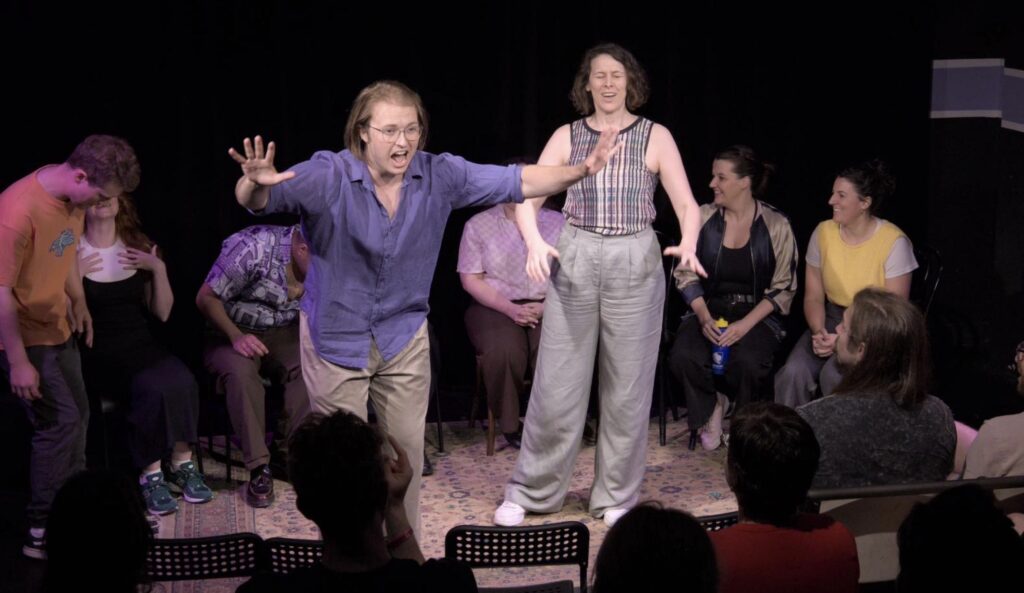
- Your family has built community in different ways and advocated for spirituality and resilience. How does this reflect in your practice?
Ahhhhh yes, the old Jensen introspection. To give the reader a brief as possible (not so brief, sorry I love my family) run down of my families livelihood: My Dad is a Reverend, a very good one, being a reverend means he’s essentially a spiritual community councillor who is in charge of the faith journey of a bunch of people for like a while. My eldest sibling is a queer community leader who works in queer and trans health care, who is also a theologian. I think every single queer person in Australia (at least on the east coast) knows AJ. My Mum is a genius nurse and midwife who is the biggest and kindest extravert in the world. I credit her brain with where I get my improv and musical capabilities, I also credit Dad’s public speaking skills. My brother has murdered and will kill again. Just kidding, Davis is a child psychologist. Very funny, gentle and generous and my one-true comedy partner. Being the youngest of this bunch was intimidating for a lot of my life. They’re all so great, smart and talented, thoughtful and big advocates in their own ways and they are all so funny. Importantly, they’re all community focussed. I really strive to spread half the goodness that they have spread as individuals.
There are many many things that influence my approach performance, but one thing I’ll talk about is my parents. My Dad’s way to guide the same congregation, to the same conclusion, with the same goddamn thousands years old text week after week was mind boggling to me until I actually went to church and saw how good he was at it. My Mum’s journey with faith was different, it came from a feeling of being very out of place. She’s a born again Christian that’s always giving me different prayers when I am at my lowest. Whenever I saw Mum’s joy at church, it latched onto me. Her experience in that space is what I try to emulate for an audience. Any time a person is at a microphone, on a stage, surrounded by a group of people, who has been given their attention, they should use that sort of power for good.
Whenever I am on a stage in front of a crowd that’s my community for the night. That’s the people I have to work with, and it’s my job to entertain them. It’s always a great chance to unite strangers through silliness. Make them laugh, make them cry, take them out of their bodies for an allotted amount of time collectively. Make the trek to the theatre worth it. I am consistently wanting to make the audience feel like they are one being. Experiencing the same thing and feeling the same way. Which is the joy of community. This is how I approach performance, not necessarily creation.
Creation for me comes from first a need to understand, second a need to be understood, third a want to make something new. A lot of my ideas start with me saying “it would be cool if…” or “isn’t it stupid that….” then posing that to the audience. However, performance is all in the room it's in. The success of improvisation and stand-up are built on the moment of its perception.
My Dad said this thing that I never really understood until I started properly performing, it was very simple - “spiritual power is really powerful”. Being a spiritual leader means people give you their shit to hold, the anguish in their souls, their grief, their sin for fucksake FOR THE INTENTION that you’ll guide them through it. Comedy is very similar - just without an explicit holding of baggage - it achieves the same outcome. Any and all mediums of comedy rely on a sort of catharsis, that is, a tension that is resolved. In stand-up, a set up builds tension and punchline cuts it. In Improv, the idea that you are improvising is tension. In a sketch, it's a tension built by the story. Whatever that tension is, can be compounded by whatever baggage audiences bring to a show. What happened in their day, a major event in the news, whatever stresses and anxiety they bring. You can always feel it in the room when people are down. When the joke/sketch/improv tension is cut, ideally the laugh occurs, and that audience tension is released. Comedy, the arts broadly, is super powerful, live performance is powerful and it’s easy to be scared of that power, that’s why a lot of people are anxious about performing. 60 eyeballs on you, 26 drunken souls heckling, 13 breaths being held, and 139 funny bones being tickled, because 1 funny person (or more) is performing. That’s crazy power. And it should be scary. So much good and so much bad can be done.
- What fuelled your urge to honour the time you lived with your 95 year old grandad?
I always wanted to do a show about living with him. It was a pretty weird and pivotal situation in my life. It was 2020, I was caught in the black summer fires, I broke up with my girlfriend, moved away from my friends, and left my home in Canberra, with my parents, to Goonellebah near Lismore, close to where I grew up for a part of my life and close to where my grandad lived. And there was a pandemic going on. It was, and remains, the bleakest, loneliest and most despairing time of my life. So I decided to move in with a man who always complains about no one visiting him, has expected death for most of his life, and has seldom uttered the words ‘I’m proud of you son’ to my father. Richard ‘FaFa’ Jensen.
An eccentric Danish 95 year old man who was a part of the Danish Resistance in WW2, travelled the world as part of the British Army, witnessed the Nakba and the beginnings of a genocide, encountered a bear in Canada, worked in Mexico for a number of years as an illegal construction worker, was offered a job as a literal slave master in Papua New Guinea, took the fucking job, worked it for a day, was terrible at being a slave master (thank god), then was recommended work as a surveyor across the road. He met a match maker in Papua New Guinea that matched him with an Australian teacher, my gran, they fell in love at first sight (I assume out of necessity, they were in their 30’s and this was the 50’s) and here I am. My gran passed away in 2014, so he lived by himself in the house he built on the coast. He sort of lived a dystopian Forrest Gump life. He was quite a traumatised man, which he never ever confronted, as is tradition with grandparents. He was not a good father. My Dad has done incredible work not to recreate the sort of distant dynamic between FaFa and him and my uncle. But I got to witness a gentler, charismatic and whacky grandfather whilst being aware that he was a difficult father to my own father. So I thought I should talk about my Fafa’s traumatic life, a life of surviving and doing what was needed to live. He’s actually still alive. Surviving. At 100 years old. Living in a nursing home now, but man he’s still kicking and will probably keep going for a touch longer.
It was a sacred time of my early adulthood I hold dear as a time of immense sadness and growth. I wanted to honour my deep desolation and honour my FaFa’s traumatic journey. He was my only friend for that year and I was his. It was a way for me to acknowledge what my Dad, and my mum as well, go through when they have interacted with him. I don’t want to say I healed some generational trauma… but I definitely brought it up. I wanted to help my parents see what I see in him. Or to feel what I feel about him. I think they did. My dad says I was a bit too nice on the man. I probably was, but he’s also the oldest man I know. I’m not going to take a shit on a billion year old guy who’s related to me. That’d be crazy. But my dad’s right. There is so much to criticise about our grandparents, and our parents, but we love them all the same. They’ve been through so much. We all go through so much. At a certain point it gets quite funny how much we all go through. The trauma we endure, the questions life asks and the tenacity with which we answer. The cruel audacity of it all is just so funny. There is something we owe to our parents and grandparents, what they taught and continue to teach us, yet they have so much, too much, to answer for. Holding those two innately true things is a really difficult task. One best done laughing.