
Creative Profile. Circle Paints
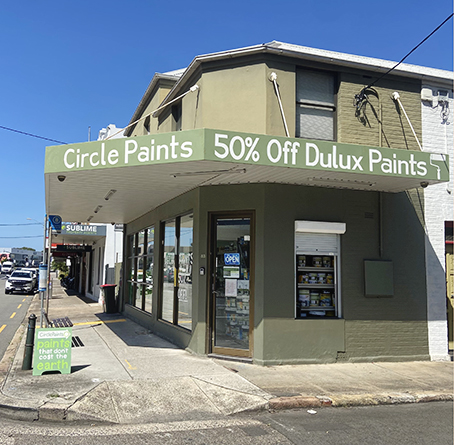
Circle Paints is Sydney’s cheapest paint shop, selling high-quality interior and exterior paints and wood care products. They collect surplus paint from trade painters and wood care products from Community Recycling Centres that is otherwise destined for landfill or incineration and make it available for purchase through their online store. Their customers are people on tight budgets, and businesses, community groups, and individuals who want to play their part in creating a sustainable economy by choosing to recycle and reuse wherever possible.
I understand that Circle Paints was inspired by Seagulls Reuse in the UK. Can you tell us that story?
Over ten years ago, Jocelyn – the founder of Circle Paints – heard about Seagulls Reuse in Leeds, and thought that there should be an enterprise like Seagulls in Australia. Fast forward ten years and she finally had the time and savings to launch a paint reuse startup. She reached out to the founder of Seagulls Reuse, Cat Hyde, who was very generous with her time. Cat shared everything she had learnt over 15 years of running a paint reuse enterprise, and she is still an inspiration and adviser to Circle Paints.
Reducing the carbon footprint seems to be a major motivation. Can you describe your contribution to that?
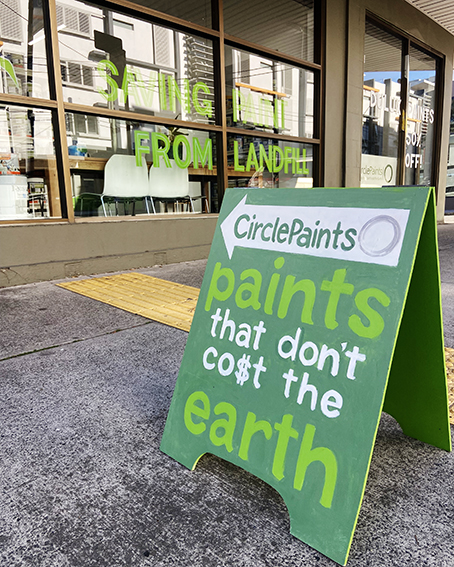
Reducing carbon emissions is the central goal of Circle Paints (and climate anxiety its main source of energy!) with affordable, high-quality paint being a spin-off benefit for customers. Construction represents a huge chunk of Australia’s carbon emissions, and paint waste was a segment that nobody else seemed likely to tackle. Paint is a very high carbon material – with the manufacture of 1L of paint releasing six times as much carbon as the manufacture of 1kg of concrete. Paint production also generates 38% more carbon than production of 1kg of steel.
Is there something governments should be doing to reduce paint waste?
The best action that governments could take to reduce usable paint going to landfill is to specify the use of reused and recycled materials in their own building projects. This would create a strong market for sustainable products like reused paint.
The next most important change governments could make is increasing the paint waste levy, then using the extra funds to pay waste generators to direct their surplus paint to reuse and recycling enterprises, and to subsidise paint reuse and recycling. Paint reuse is labour intensive and expensive, and its viability is borderline without the assistance of waste levies.
How is what you do different from what the ‘Paintback’ scheme does?
There are some key differences between Circle Paints and Paintback. Paintback is funded by a 15 cent levy on each litre of new paint sold in Australia, whereas Circle Paints is solely funded by paint sales. Paintback is primarily focused on ensuring that water-based waste paint is disposed of responsibly, by drying out water-based paint prior to sending it to landfill, and facilitating reprocessing of oil-based paint for use as cement kiln fuel, whereas Circle Paints is dedicated to ensuring that paint is used as intended – to paint things! Encouragingly, Paintback now reprocesses a small proportion of waste paint in Victoria as “Greyscale Paint” for painting over graffiti. Greyscale production is not yet operating in NSW.
How do you ensure that the recycled paints are of ‘as new’ quality and what expertise do you draw on?
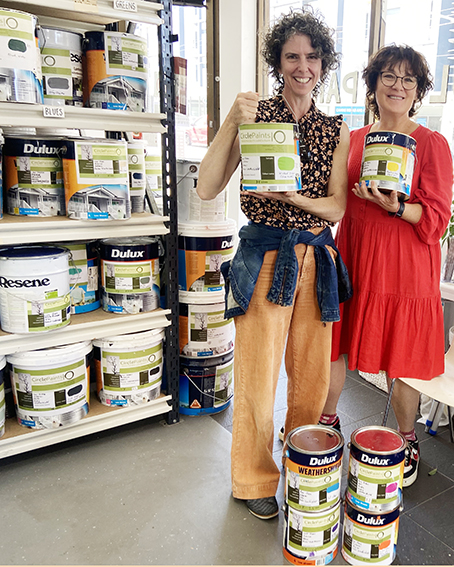
Our paint is not recycled. Instead, we select only paint in good or excellent condition for reuse. About 20% of our paint comprises new, unopened tins and tubs that were either tinted incorrectly by a paint shop or over-purchased for a large-scale project. This paint is new – not just “as new”.
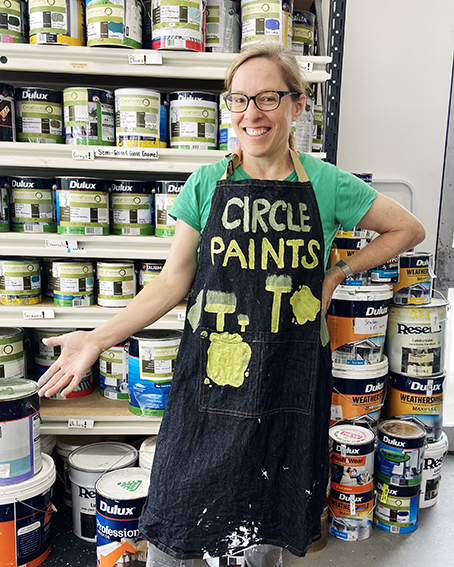
The rest of our paint comprises partly used tins and tubs, so volunteers check it carefully for lumps or other contamination. We aim to have paint that is high quality, but this can prove challenging for some paint types – especially ceiling paint, which is prone to contamination by dried paint flakes dropping off the lid or off the inside walls of the tin or tub. We strain paint if we observe dried paint flakes or lumps provided the paint otherwise appears to be in very good condition.
Why do you use 95% Dulux paint?
The emphasis on Dulux paint partly reflects what brands of paint we’re given and partly reflects customer preferences. Nearly all of Sydney’s trade painters use Dulux, so Dulux paint is what they donate to us. We also observe that our customers generally prefer Dulux paints (it’s a NSW thing), so we generally decline donations of other brands of paint. That said, we actually believe that Resene paint is better quality than any Dulux paint, and we also believe that Taubmans Endure interior is better than Dulux Wash&Wear. However our customers want what they want, so we have to follow their lead.
What sort of feedback do you get from customers?
Our feedback is overwhelmingly positive. About half of our customers just want very cheap paint, and are delighted that we help them save money. The other half of our customers are delighted that we enable them to participate in the circular economy. Our favourite customers are the ones who take the time to leave us a review or do a Facebook post about their purchase. We wouldn’t exist without their help, because nearly all of our new customers hear about us through recommendations from friends, Facebook posts, or Google reviews.
Do any artists use your paints? If so, who and how?
Over 30 of Sydney’s mural artists regularly purchase from us, and visiting mural artists also pop in and stock up for local commissions. Some of our favourite customers are @kellwallwork, @fangarooinsta, @gulliverhancock, @lesjak_atton, @pilar.basa, @jskooridesigns, @elbows1, @mangoootango, @littleflyingpiggy, @davidcragg, @strachenrosemary of “Skippy Girls” fame, @michellesullivanclay, @giovannadasilva_, @juileepryor, @sahilroy__…the list goes on.
Do you see the opportunity for similar enterprises recycling other materials?
We’d like to call out the awesome team at @amongthetrees who save timber from landfill. There are also other enterprises around Sydney that are saving roof tiles, windows/doors, and other high value building materials. But it’s a challenge to build an enterprise at a scale that works economically in a country where there is no price on carbon and landfill is so cheap. Reuse is a really tough proposition economically in the current environment.
How does this work press your creative buttons?
We are always STOKED to see our paint being used for art and for other creative uses like theatre sets (those sets for Seussical the Musical @innerwestdrama were gorgeous!). Some of our volunteers are artists, and free paint is a fringe benefit of volunteering with us. We love their work too. We’re always energised by seeing the beauty and drama that can be created using materials that were going to be buried six feet under.
Article by Tamara Winikoff
Tamara Winikoff is an independent consultant with extensive experience in arts advocacy, policy, and cultural leadership. She was a a founding member of the Inner West Creative Network and served as Executive Director of the National Association for the Visual Arts (NAVA) for 22 years, championing artists’ rights and sector development. As Co-convenor of ArtsPeak, she coordinated national arts policy initiatives. Previously, she managed the Community, Environment, Art and Design (CEAD) program at the Australia Council for the Arts and lectured in Cultural Environment and Heritage at Macquarie University. Based in Sydney, she continues to influence the cultural landscape through strategic consultancy.