
Creative Profile: Mark Elliott
Mark Eliott is a contemporary artist working primarily in flame-worked glass and incorporating a variety of mediums such as text, music, stop-motion animation and wood carving. His formal training includes a Master of Visual Arts and Master of Studio Arts at Sydney College of the Arts as well as an Associate Diploma in Jazz Studies (saxophone) at Sydney Conservatorium of Music. Mark has taught glass flame-work in Sydney, Melbourne and Canberra where he generously provides interactive demonstrations. His work is held in many private and public collections and is on sale at a number of galleries around Australia. Additionally, he has a strong interest in environmental issues, continues to play music and lives with his family in Kingsford Sydney. Mark’s studio is at Among the Trees in Marrickville.
Your work explores a number of mediums and themes which it would be interesting to tease out.
One theme is the witty representation of biological organisms. What ideas are these expressing and how are they influenced by 19th -20th century glassblowers?
I’m not sure if witty is the word. Representing a living thing for me, is an act of worship. If I have any religious allegiance, it is to our greater family of life. It can also be a relief from the obsession with your own artistic identity. The humbling things is that it’s not possible to fully achieve.
Leopold and Rudolph Blaschka meticulously crafted glass biological representations that have influenced many of us in the field of glass flame-work.
What is it with you and birds, clouds and pseudo-scientific apparatus?
Birds: my father had many birdlike qualities including an impressive beak. I sometimes think he left this life on the wing, like his beloved Albatross, gliding into the soft grey clouds from whence all colours come.
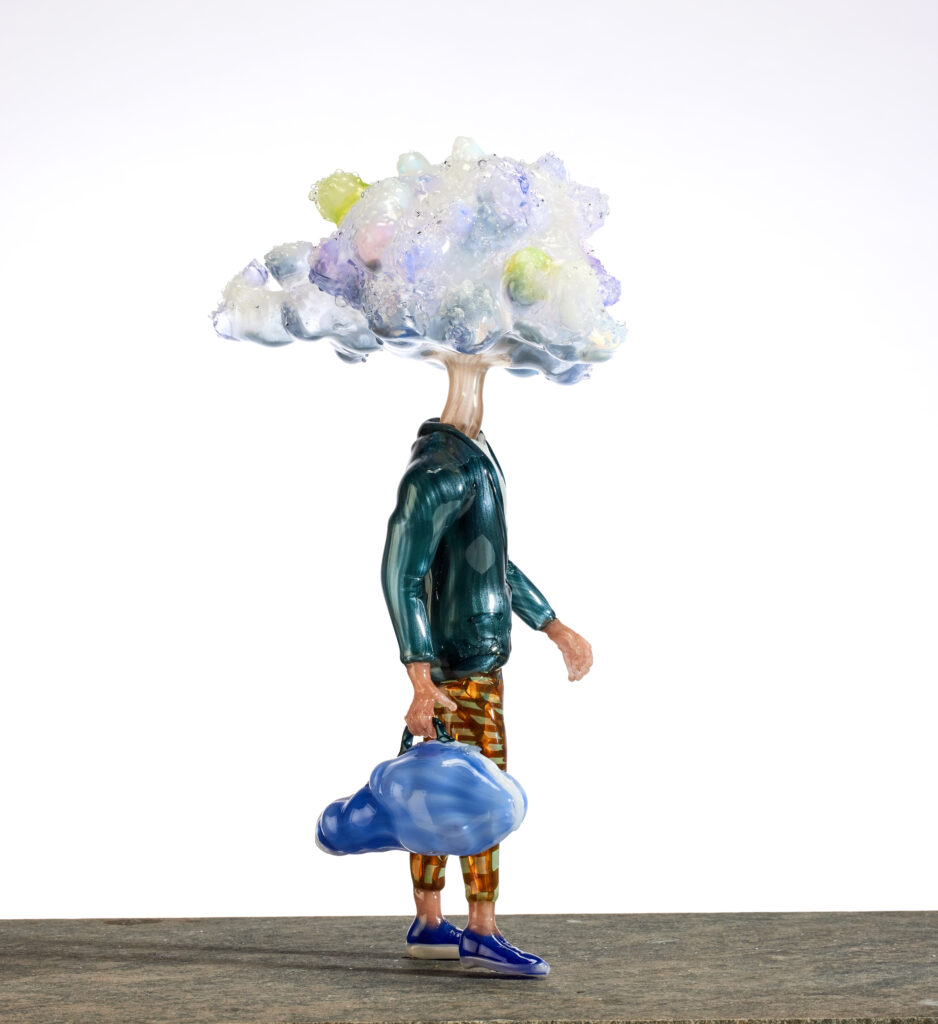
Clouds: pareidolia is the word for seeing recognisable forms and patterns in random phenomena such as clouds. This is a very improvisational human instinct. One might see a cloud goddess gazing down in wonder and perplexity as she waters her garden of life.
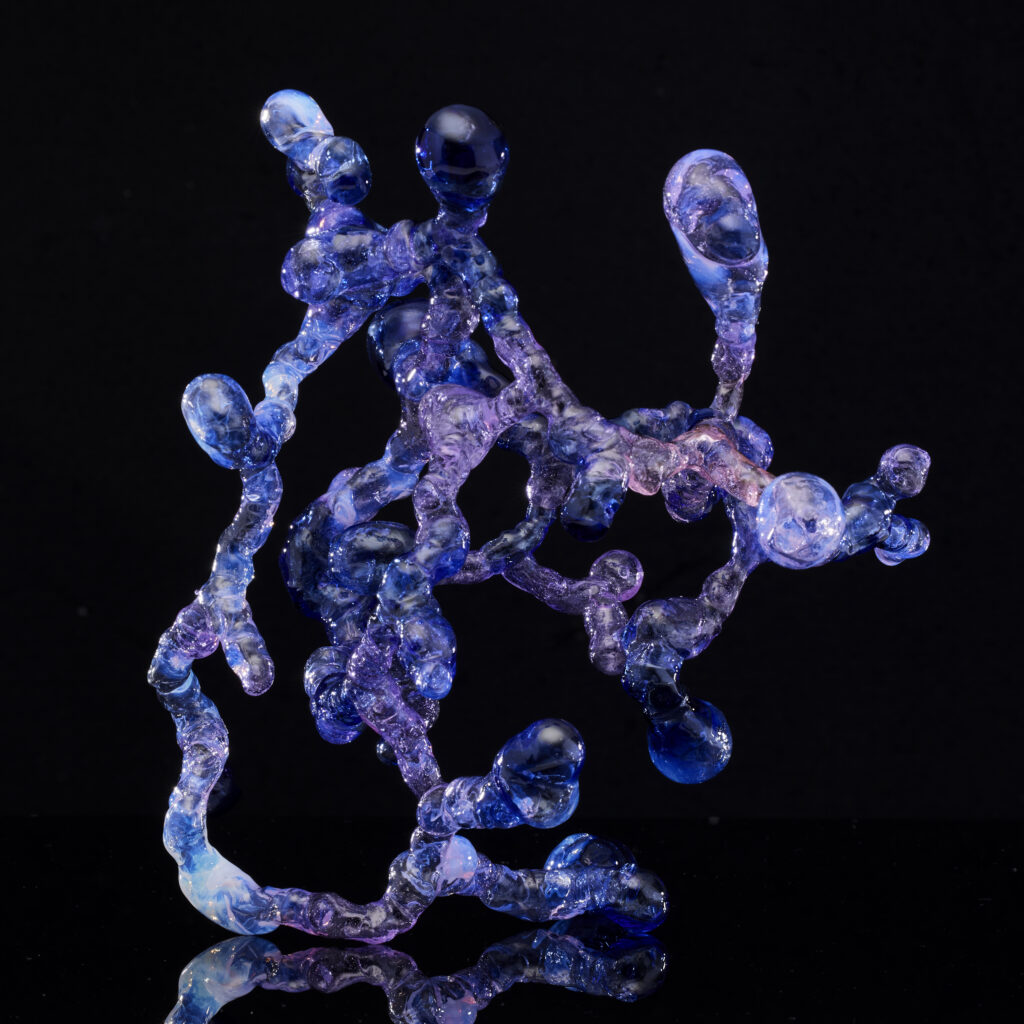
Scientific apparatus: I got my start in glass at Minson scientific glass factory in Sydney. I’m not skilled at blowing laboratory glassware but I like the shapes and forms. My apparatus is usually in the service of storytelling for example my Cloud Essence Condenser was ostensibly used by 19th century naturalist Professor Hamish McFoggarty, who sailed the world collecting Cloud Essence in his floating cloud laboratory.
You tantalisingly describe a theme in your work as “synaesthesia and the dance between improvisation and structure”. Please explain.
Synaesthesia is the overlapping of the senses which some of us experience. Mostly it’s not very useful. For example, who cares that I see Fridays as slim and deep red while my sister might see them as fat and blue. For an artist, however, the peculiarities of the lens through which you view the world inevitably feeds into your artwork.
Much of my work is planned and involves sketches, premixing of colours and fabricating larger works by joining small premade elements but there is always a degree of uncertainty. I also like to return to the naivety of jumping in without a plan and seeing what develops.
Another of your interests is the writing and the telling of stories through objects, often inspired by mythology. Can you tell us about mythology in your stories and how your father’s story telling influenced you?
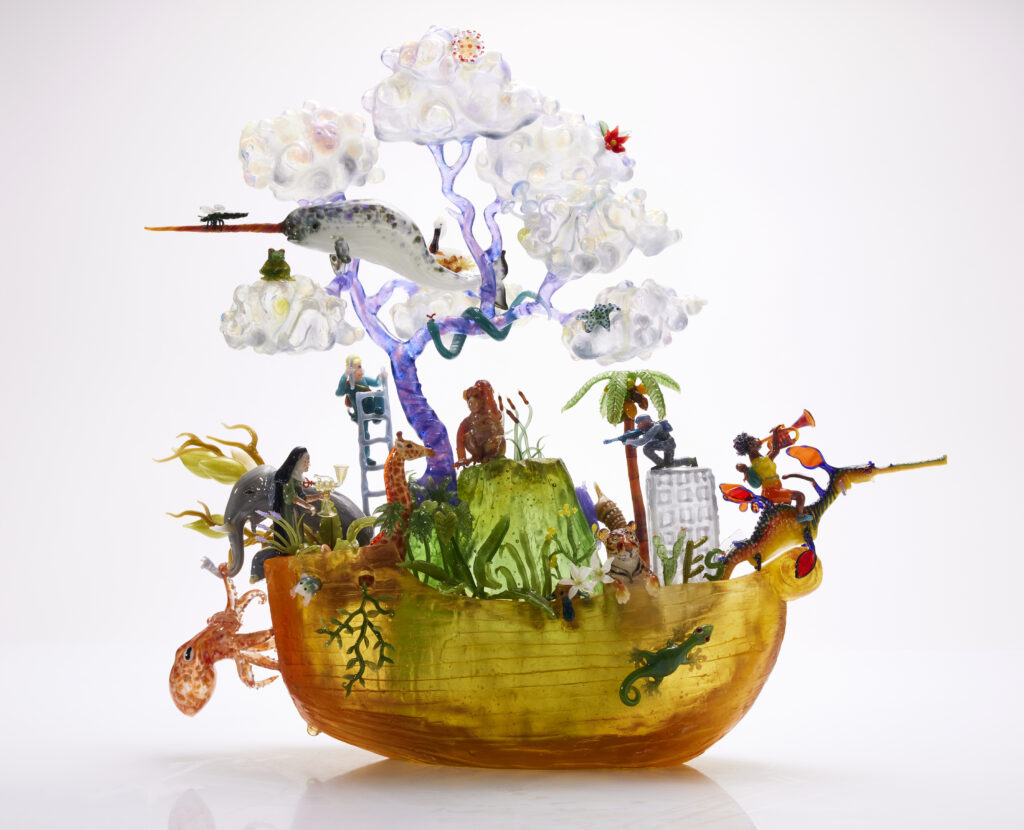
Storytelling is a big part of what we are about as a species. We are always trying to weave meaning out of chaos. My brain is not very encyclopaedic so I am often reinventing the wheel; getting excited about the discovery of a new story which grows like a seedling in the compost heap of memory.
My father was an actor. He used to enthral my sisters and me with bedtime stories by candlelight. We thought he was teasing us when he paced up and down the hallway, keeping us waiting in our bunkbeds before he started. Later I realized he was sketching the story in his mind so that he at least had a starting point.
Your approach can include stop-motion animation projects for which you have coined the term ‘flame-ation’ (flame-glass animation). How do you use this, sometimes along with live performance, to animate your artworks?
Jack McGrath and I developed Flame-ation as a collaborative masters research project at Sydney College of the Arts. Think Claymation but with hot glass. It can be very performative such as when we set up the Flame-ation Station at Canberra Glassworks. A group of flame work artists contributed to evolving sculptural forms passed round the table and photographed in front of a greenscreen, in view of a live audience and simultaneously screened above.
Does music inform your art work and vice versa?
Music is very visual for me, whether it’s an undulating soundscape in some improvised jazz or the finely crafted shape of a good pop song. I might create a sculptural representation of a music solo in glass because that’s how I see it when I’m playing the saxophone. Conversely, I often feel like I’m sculpting shapes when I play music. Songs are also vessels for carrying stories, as are books, films and visual artworks.
One of your guiding principles is collaboration with other artists. What are the challenges in trying to match your artistic vision and skills with others?
Collaboration is both exciting and uncomfortable because your ideas have to evolve when others get involved. It’s always a work in progress, like co-parenting. Your ideas and those of your collaborators often differ but as Aristotle once said, ”the whole is greater than the sum of its parts”.
Glass sculpting is a very exacting skill. As a teacher, how do you approach helping people to become enchanted by this medium?
My main teaching approach with beginners is to begin with free-form, improvised shapes. I find this leads to an easier ride and more unique results than starting with a plan.
Examples of your work have been collected by institutions around the world. Do you feel sad to let go of your creations?
Sure, but artworks need to take flight in the world beyond your studio. I feel better when the work goes to a good home and the sale is not so much a transaction but a kind of mutual gifting.
Another of your preoccupations is with environmental issues. How can artists help, and do you maintain hope for the natural world?
For one thing, it depends how you define the word ‘artist’. Perhaps those people wandering around in floppy sunhats, looking out for endangered species and tending to the bush are themselves artists collaborating with life in the landscape. I think you have to have hope. I search for ways to convey environmental messages that maintain a sense of optimism. We live in a beautiful world full of wonder and extraordinary organisms including people. It’s worth doing our best to protect life.
Explore more of Mark's work at www.markeliottglass.com
Tamara Winikoff is an independent consultant with extensive experience in arts advocacy, policy, and cultural leadership. She was a a founding member of the Inner West Creative Network and served as Executive Director of the National Association for the Visual Arts (NAVA) for 22 years, championing artists’ rights and sector development. As Co-convenor of ArtsPeak, she coordinated national arts policy initiatives. Previously, she managed the Community, Environment, Art and Design (CEAD) program at the Australia Council for the Arts and lectured in Cultural Environment and Heritage at Macquarie University. Based in Sydney, she continues to influence the cultural landscape through strategic consultancy.