
Creative Profile: STEAMpop
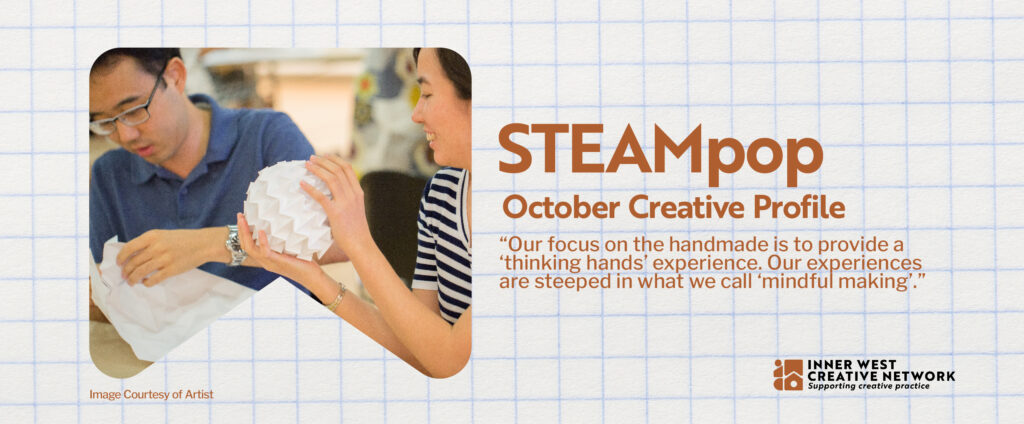
STEAMpop is an organisation co-directed by Dr. Melissa Silk and Annette Mauer, in creative partnership with Lisa Giles. They offer creative workshop facilitators presenting playful and unique making activities suitable for a variety of audiences including community, education and corporate. They design and provide unique hands on, transdisciplinary experiences demonstrating innovative methods of engaging with STEAM. Their experiences cater for all people interested in exploring new ways of integrating the Arts with STEM. They collaborate with exciting creators to develop high quality, imaginative STEAM experiences incorporating STEM concepts with the beauty of the handmade. Their projects are primarily paper-based and grounded in simple mathematical concepts. In this way they contribute to current research aligned with transdisciplinary learning and transformative experiences.
1.What is the origin story of STEAMpop?
A while ago Melissa was teaching young people to design things using STEM principles, collaborating with maths and science teachers. Annette was teaching visual arts before moving into creating exhibition resources for the Australian Design Centre (ADC). Our surprise collision resulted in the ADC exhibition of the “Possibilities of the Parabola” project that Melissa had been teaching to teenagers in school. From there a friendship and partnership developed that has continued to grow and develop for over 10 years.
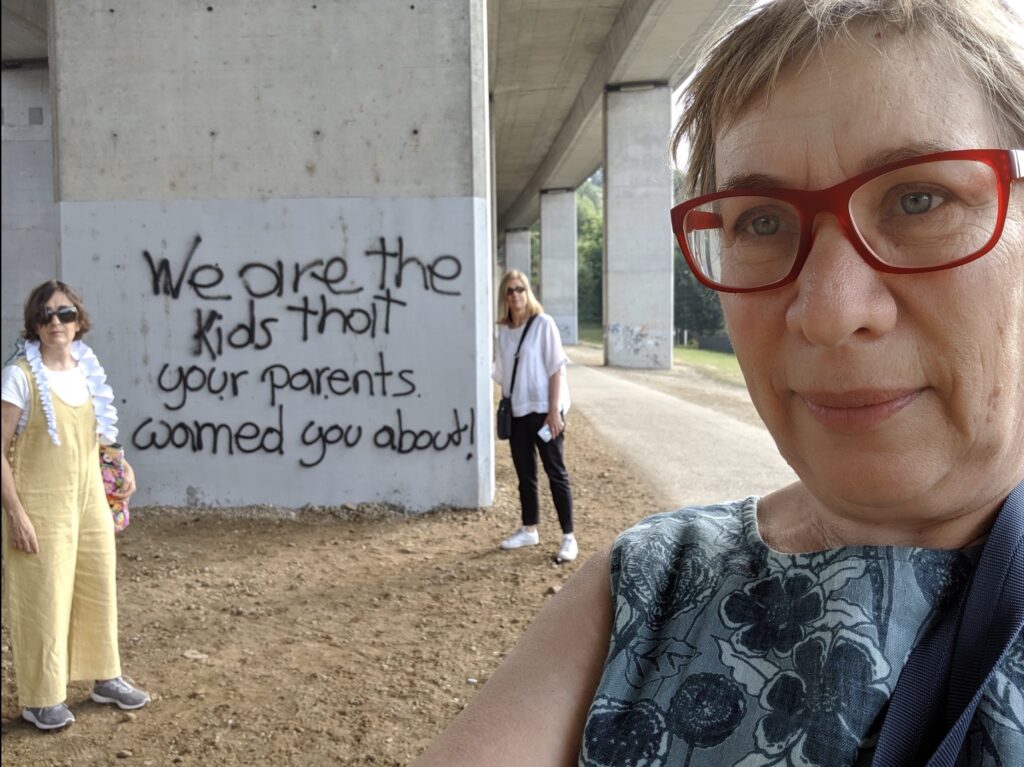
STEAMpop evolved from a collaborative idea to share our great interest in the intersection between STEM (science, technology, engineering and maths) with art and design practice (the A in STEAM). Our background in education and design and museum public programs gives us great insight into what audiences might want to experience in an event where they learn about an idea and apply that learning into making something unique and memorable. So we have been doing just that with many different audiences and , sometimes in unexpected places like Austria and Finland!
2. For some people STEM can be quite incomprehensible at first sight; which entry points do you offer in your experience for people to embrace it all?
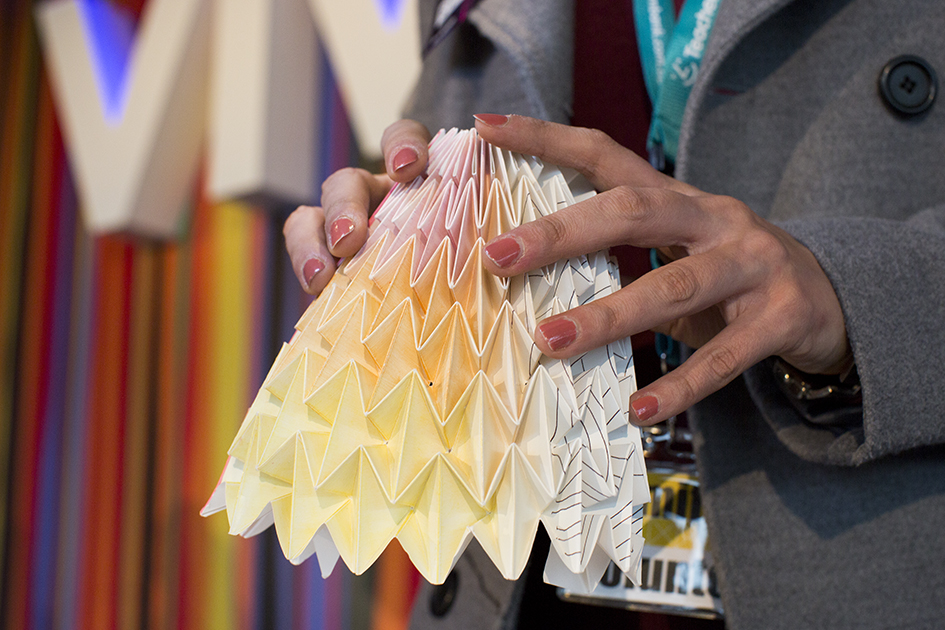
The maths we use as a foundation for all our projects is important for the participant’s making experience. It’s very accessible to an audience because we point out where the maths occurs in everyday life. This part is wonderful because of its simplicity. What we like to stress is that the item they are making is not possible without mathematics. It is the ‘existential truth’ that underpins everything we do. The maths provides a gateway to the engineering and tech aspects of the projects. It also can provide the basis of the aesthetics in the objects that we create. We always try to collaborate with experts to validate and deliver our ideas, which often leads to a super entertaining experience. We often collaborate with paper artist Lisa Giles. Lisa has assisted us in further explorations of a number of paper folding techniques. We have also worked with programmers, astro-physicists, dancers, mathematicians and storytellers to enhance the audience experience. The best aspect of all of this is that people make something beautiful with their own hands and take it home to enjoy.
3. Was there a particular reference or inspiration that prompted your application of STEM into the handmade?
The connection between science and mathematics to art and design is not new, however it is often not well recognised. As part of our workshop delivery we try to highlight both the historical and contemporary connections. We may reference Islamic tiles or MC Escher ans pay particular attention to the work of physicists Jun Mitani and Robert Lang for many of paper engineering techniques we use, as well as designers Richard Sweeney and Paul Jackson. We refer to fashion designers and technologists such as Iris Van Herpen and Sonia Delaunay when considering experiments in technology and construction. These artists and designers focus on the importance of the handmade. This focus, as well as the ‘experience’ of slow making is paramount to the STEAMpop experience.
4. What do you consider important when facilitating hands on projects through STEAM principles?
We mainly focused on paper as a medium for making, sometimes throwing in a little mechatronics to spice up the outcome. Our focus on the handmade is to provide a ‘thinking hands’ experience. Our experiences are steeped in what we call ‘mindful making’. The most important aspect of our facilitation is to encourage participants in the workshops to keep going and complete making the items themselves. Of course, sometimes we have to step in and fix the odd bit here and there but it’s mainly the sense of individual and collective achievement that we are after. Then each person can see how their understanding of some simple geometry has led to a joyful outcome. Many of our projects light up on completion, which is an extra moment of joy!
5. What topics do you find critical to be on the same page when collaborating with other orgs in order to generate impactful, sustainable and non extractive work?
It’s important that organisations support each other in the efforts to encourage people in various communities to come together and experience something wonderful. We keep material waste to a minimum, often repurposing leftover materials into other projects. The impact of participating in a STEAMpop workshop is frequently combined with the location in which the experience took place. Working with other organisations, small and large, embeds our unique experiences in community contexts with a view to the individual experience being as important as remembering where and when it happened.
6. What was the inflection point that made you shift from sculptural structures into wearable art?
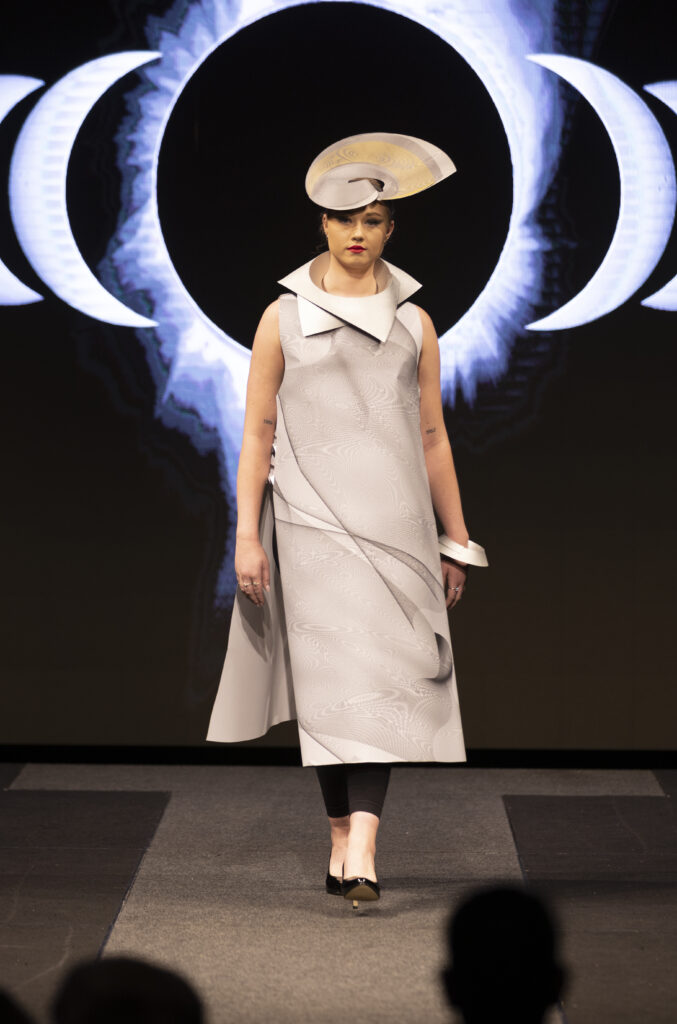
Working with different folds and paper manipulation techniques we began experimenting with small modular pieces to create neckpieces and then hats. We were excited about the possibilities inherent in wearables as an artform embracing STEAM themes and workshop programs. Together with Lisa Giles we have twice been finalists in Paper on Skin, a wearable art exhibition held biannually in Tasmania. This really pushed our practice in new directions. All of our wearables have foundations in geometry and topology, emerging from simple circular iterations and playful interpretations of the Mobius band. Just recently, Melissa presented a range of our wearables at the Bridges Math Art Fashion show in Galway to great applause. This was super cool.
7. What is your current artistic obsession?
We are obsessed with a geometric pattern called the ‘Glide Reflection’ and also any aspect of our projects that have potential for photoluminescence. That is, they glow in the dark. The Making it Count exhibition has encouraged us to explore different mathematical concepts and to translate these into artworks. It’s been lots of fun developing ideas and making the pieces. It’s also an opportunity to do corresponding STEAMpop workshops while the show is presented at Sydney St Gallery. There is a workshop for Sydney Craft Week based on Mobius millinery, similar to our making workshops at Momath in New York City and recently in Galway. This will be a lot of fun!