
Creative Profile: Suganthi Singarayar
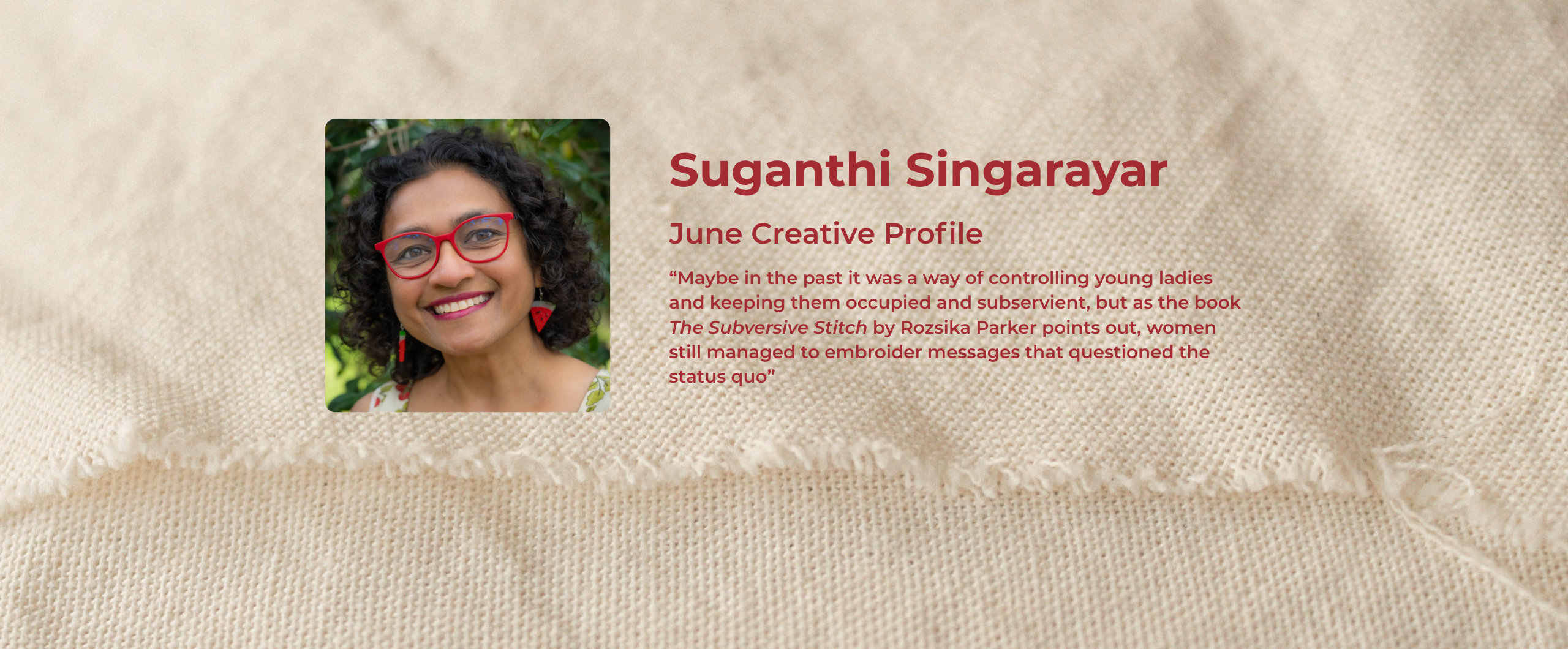
Suganthi Singarayar is a Sydney based contemporary embroidery artist. She loves experimenting with and learning different embroidery techniques which she then incorporates into her own art practice. She trained and worked as a journalist and for many years focused her writing on issues of social justice. Suganthi’s interest in politics and world affairs often informs her art work as does the ability to transform the shape of a flower, a place visited, or an idea into stitch.
Her work was most recently showcased in the ‘Timelessness of Stitch’ exhibition at Timeless Textiles in Newcastle and in June, she is taking part in the ‘Divide by Zero’ exhibition at Sydney Street Gallery. She is a member of the Design Divas group who will exhibit at Gallery76 part of the Embroiderers’ Guild NSW from 25 September to 20 October 2026.
How and why did you start using embroidery as your preferred expressive medium?
I originally learned smocking and in 2019 I undertook Contemporary Stitch and Design with Mary Brown at the Embroiderers’ Guild NSW (EGNSW). At that time I wanted to marry embroidery with my writing to make pretty pictures! I was not intending to do political pieces. However, my first assignment saw me creating what I would consider to be a political work: Lament – TUAM. It is a lament for the men who are not mentioned in current news stories about children who were taken away from their unwed mothers in the 1950s, 60s or 70s. My immediate reaction has always been: “What happened to the men? The women did not get pregnant by themselves.”
I had a similar reaction when reading, “Blood on the Rosary” by Sue Smethurst and Margaret Harrod. In the epilogue Margaret Harrod says that as she was writing her book a new scandal involving the Catholic church was unfolding on the other side of the world. The bodies of 796 babies were exhumed from a mass grave under a playground on the site of a former Mother and Baby home run by Bon Secours nuns in the Irish town of Tuam in County Galway.
My piece was a means to express my emotions at reading this information. It was a way of telling a story that is different from journalism. In many ways I am finding this journey into stitch quite difficult because as a journalist you do not express an opinion; you are a conduit for information, and you endeavour to present it in an unbiased way so that other people may form an opinion.
What sort of training did you get?
I learned smocking with Lesley Turner and at the EGNSW I have undertaken Essential Embroidery Techniques and Contemporary Stitch and Design (now Contemporary Art and Stitch). I have also done a Drawing course through TAFE, and I continue to undertake courses and workshops.
Embroidery has a long tradition in many cultures. What are your cultural influences?
Having grown up in the West my cultural influences are ‘unfortunately’ of the West. I say unfortunately quite tongue in cheek because my name conjures up ‘exotic’ influences! And unfortunately, having grown up in England, Sri Lanka, Zambia and Australia, I’m just your garden variety product, brought up in the West under colonisation!
Is contemporary embroidery different from what was done in the past? If so, how?
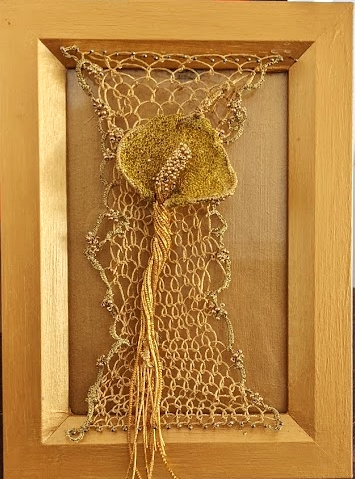
I think for me, contemporary embroidery means that you take the traditional embroidery techniques of the past and you create contemporary pieces. This is a continuation of a long tradition of people creating contemporary works that reflect the times in which they live. EGNSW has a collection of items from the ‘50s, ‘60s and ‘70s. At that time they would have been cutting edge and in fact they are still cutting edge, because of the materials, fabrics and design ideas that they used.
Your work incorporates a variety of techniques. Can you describe them and what is technically involved? What have you learned from other craftspeople?
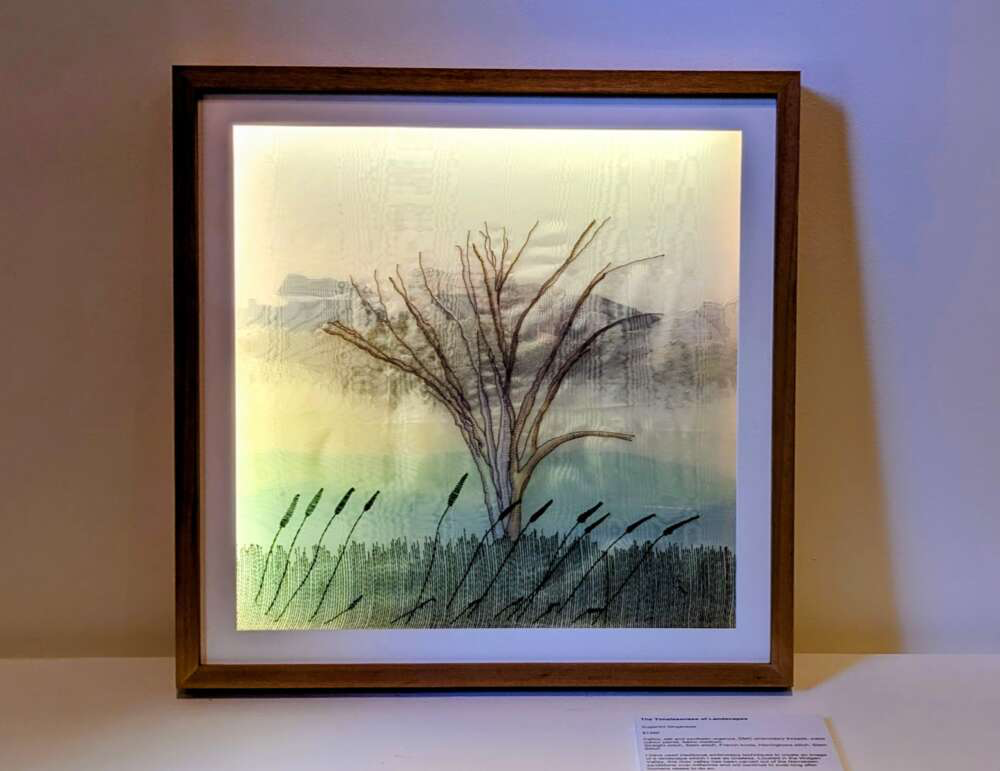
I use traditional embroidery stitches, such as French knots, stem stitch, straight stitch etc to create images. I also use metal thread embroidery. I have done and will continue to undertake workshops that will help to inform my practice. For instance, I did a workshop with Alysn Midgelow Marsden at Timeless Textiles in Newcastle where I learned to iron wax and gilt onto scrunched up paper, which I then stitched over for my piece, Wolgan Valley: Clouds
Do you resist embroidery being regarded as a female pastime?
No, not really. It is a female pastime. I don’t know if you are mentioning it as an epithet or pejoratively? But it is a female pastime and something that gives great joy and contentment to a lot of people. Maybe in the past it was a way of controlling young ladies and keeping them occupied and subservient, but as the book The Subversive Stitch by Rozsika Parker points out, women still managed to embroider messages that questioned the status quo. It is also a way of making money. In the past, master artisan positions were held by men and were tightly controlled by Guilds. In India, men were employed in commercial and luxury work as they were able to work outside the family home. My understanding is that in India it is still mainly men who are employed in commercial and luxury work, however the gender disparity seems to be changing.
Some of your work is about landscapes. How do you deal with the challenge in the detail of embroidery trying to represent the scale of these landscapes?
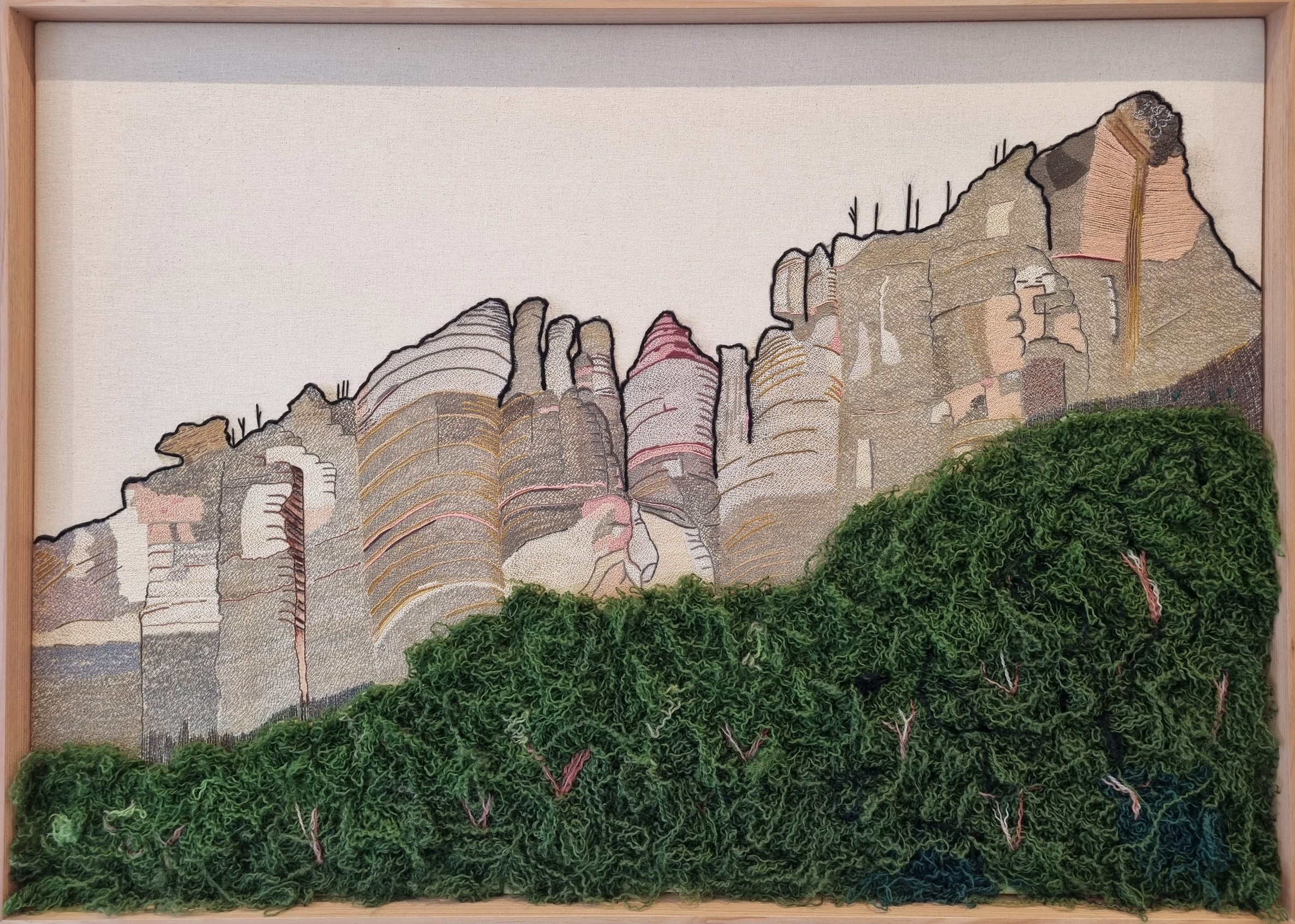
This is an interesting question. A lot of artists tend to use big strokes when creating large works, therefore big stitches and thicker threads. However, I like small stitches and find that they are very effective in creating the big landscapes. Time constraints mean that you do think of other ways of creating. For example, with Impressions I: After the fires (2023), instead of making individual eucalyptus trees to denote the forest that grows to the cliff line in the Wolgan Valley, I pulled apart tapestry yarn and couched (stitched) it to the substrate, to create a sea of textured green.
What political issues concern you and how can embroidery be used as an effective medium for political commentary?
This is something that I am still coming to grips with. Is embroidery an effective medium for political commentary? If so why and how? Is it only seen by a few people who are interested in textiles? In art? In embroidery? Does it have any effect on the outside world? I know that there are many examples of stitch that question the status quo and Palestinian Tatreez in and of itself is resistance. For me, it’s a way of expressing thoughts and ideas around issues of social justice. My small Palestinian works are my way of saying that I’m sorry for what is going on because I have no other way of expressing my thoughts or influencing events.
Tamara Winikoff is an independent consultant with extensive experience in arts advocacy, policy, and cultural leadership. She was a a founding member of the Inner West Creative Network and served as Executive Director of the National Association for the Visual Arts (NAVA) for 22 years, championing artists’ rights and sector development. As Co-convenor of ArtsPeak, she coordinated national arts policy initiatives. Previously, she managed the Community, Environment, Art and Design (CEAD) program at the Australia Council for the Arts and lectured in Cultural Environment and Heritage at Macquarie University. Based in Sydney, she continues to influence the cultural landscape through strategic consultancy.